
Travel Guides & Tips in this video
Blondie In China travels to Lugu Lake to meet Mosuo people, whose matrilineal family structure and traditions are often misunderstood. The area is more commercialized and tourist-oriented than she expected, prompting a reflection on the assumptions visitors bring with them. She shares a meal with a local Mosuo man and discusses how food is served, including the custom of offering two scoops rather than one. At the Mosuo museum, she learns about cultural changes over recent decades. Conversations cover walking marriages, or Zou Hun, and clarify that the practice does not mean children grow up without involved fathers: family life centers on the mother’s household and wider kin. The visit also explores how tourism and modernization affect cultural continuity, while local people express both pride in their heritage and challenges in balancing tradition with outside influences.
Next travel video:

More about the current video:()

First impressions at Lugu Lake
Blondie In China travels to Lugu Lake, home to the Mosuo people, and arrives expecting a remote, untouched community. What she finds is a more commercialized and tourist-oriented area than she had pictured. That difference becomes an early lesson in the video: expectations formed before a trip can obscure the real place and the people who live there. The visit includes a meal with a local Mosuo man. They discuss traditional dishes and the meaning of serving food. One custom is to give two scoops; offering one is considered rude. A practical detail for visitors is that access to Lugu Lake requires passing a checkpoint and buying a ticket. The video also mentions guesthouses and hotels opened by local families near traditional homes as tourism demand has grown.
Family customs and change
The conversation introduces the Mosuo family structure, where the grandmother heads the household and men do not live in the family home. Blondie asks about walking marriages, or Zou Hun, and the account challenges the misconception that the custom leaves children without fathers. The emphasis is on family unity and kinship rather than on marriage as the organizing bond. A visit to the Mosuo museum provides context for changes over recent decades. The people she speaks with describe pride in their heritage alongside the difficulty of balancing tradition with a modern world and a growing tourism economy.
The trip is also a personal reflection on connection. Blondie considers how offline relationships and community life can be affected by modernization and constant digital contact. She does not present one encounter as a complete definition of Mosuo culture; the video follows the perspectives shared during the visit and the specific places she sees. Lugu Lake’s tourism infrastructure, the museum, the meal and the discussion of family customs together show a community negotiating outside attention while maintaining its own practices.
Blondie’s conversations also address the difference between what a visitor may assume and what residents explain. The family home is organized around women and the maternal line, with the grandmother holding a central role. Men do not live in that household, but the video specifically rejects the assumption that children therefore lack fathers or family support. The phrase walking marriage refers to a relationship custom, not to an absence of kinship or care. At the museum, exhibits and discussion give her another way to understand how life has changed over recent decades. The area’s guesthouses and hotels, including those run by local families near traditional homes, show how tourism brings new livelihoods while also changing the setting. A checkpoint and ticket are part of reaching the lake, and visitors should be prepared for the more developed tourist area she encounters. Her reflections on offline relationships grow out of the conversations and observations made during this trip, not a claim that every Mosuo family shares an identical experience.
FAQs (From the traveler's perspective)
- Q: Do you think it would be better if tourists didn't come, or is it okay if they come visit?
- A: You can come. Because people are communicating with people all over the world. You can't say we Mosuo should be an exception. And in order to preserve our culture, we must keep people out. That's not possible. Because culture has always been fluid. If your culture is dead, it would also be lifeless. So I think there is no problem with communication. I think the main thing is when it comes to our own people. How do we perceive our own culture? How can we make some cultural trade-offs? We also very much hope more people can truly understand our culture, understand our goodness, and imitate our values like respecting our mothers, respecting women. I hope people can learn from us.
- Q: How did this preserved pork become like this?
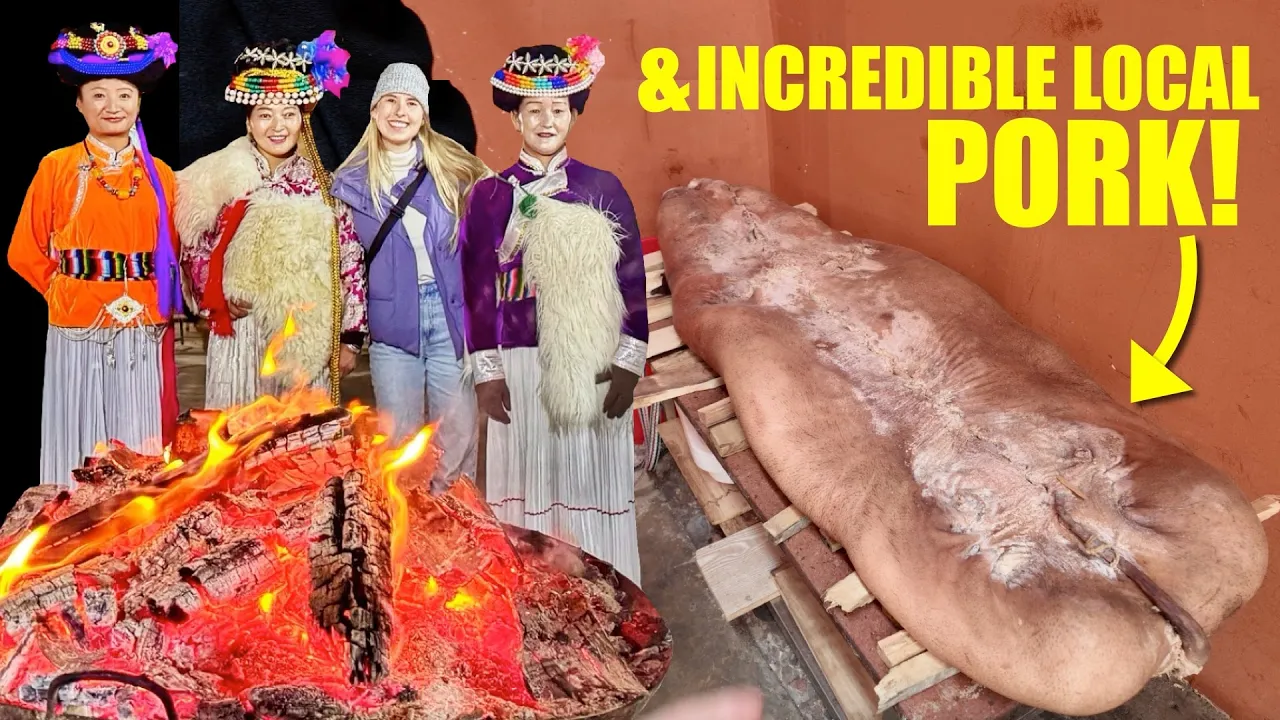
- A: First, I need to get rid of the lean meat and bones inside. Then, I add two seasonings. One is peppercorn, one is table salt. Then I put it in a ventilated and cool place. And let it ferment naturally.
- Q: What is special about this rice noodle?
- A: I made this rice noodle with plateau red rice. This red rice, it is the only rice in the world that can be produced at such a high altitude, at 2,700 meters altitude. There's no other rice that grows higher than this. Therefore, this rice is rich in anthocyanin (natural deep red pigment), so it's red. Then I use hot water to cook the rice noodles. Then I make a soup and pour it on the rice noodles.
- Q: As society progresses, how do you maintain this rice variety?
- A: Many people have improved this rice variety by using other varieties to boost its output. But here we still use the old variety to make our red rice noodles.
- Q: What is the most important thing about Mosuo culture?
- A: Us Mosuo people, we worship our mothers, we respect our mothers. The Mother lake, Lugu Lake, we call Xinami, the sun is called Nimi, the moon is called himi, the mountain/jungle is called Jinami, the river is called Jimi, the mainland is called Renmi, the heart is called Numi, the leader is ghomi. So the most important things, the most beautiful things, the most auspicious things, the best things, we all compare it to a mother. Here at Lugu Lake, the local people really respect all the mothers in the world.
- Q: How has Mosuo culture changed over time?
- A: In this day and age, most Mosuo people get married because we have now been exposed to modern culture. We've been blending together for many years. When we two were kids, it was still very traditional here. We are in our 40s and 50s now, 30 years ago things were still very traditional here. A lot has changed in the last 30 years. Of course, we try our best to uphold our most important traditions, for example, our respect for mothers and the elderly, and the deep love we have for our children. These values are very important.
- Q: What is the division of labor between men and women in Mosuo culture?
- A: Actually, in our culture, women and men are equal. It's not like what many websites and articles advertise about us. In the traditional Mosuo culture, the division of labor between men and women is very clear. The division of labor between men and women in the Mosuo culture comes from human nature and from the nature of animals. Men represent strength, so when it comes to war, men fight, hunting is done by men, and building houses too, all men. The most important thing is the Mosuo custom that women are responsible for bringing life into the world while men look after what happens after life ends.
- Q: What is the role of the Grandmother's room?
- A: After entering our Grandmother's room, you can see that there is a side room here, so this side room, it used to be our family's 'delivery room'. The children of this family were all born in this room. When the baby is born, it's the women of the family who look after this aspect. For that entire week, men in the family do not go near this room. It's women who come and help with the births. When someone from the household leaves us, us men will take the person who has 'left' and wash their entire body from head to foot. After washing, we will wrap them in gauze, just like they were as a baby, and put them here. When doing this, it's all done by the men in the family. Women don't go near this room during that time. So it can be seen as, birth is female, death is male. Then when it comes to the topic of food and preparing the meals for the household, feeding pigs and raising children, these are mostly jobs of women.
- Q: What is the role of the father in Mosuo society?
- A: As for my biological child, I will also visit them when they need to go to school or something. I will pay my share of responsibility and will give them some financial support where needed. I will also encourage them emotionally. However, at the end of the day, I will spend more of my time taking care of my sister and her children in my own household.
- Q: How do Mosuo people form relationships?
- A: So in the course of daily life, for example, through campfire parties, we'll have the opportunity to meet women and make connections. If two people have a good connection, they might start dating and form a relationship. After they're in a relationship, after a period of time, the man will start to visit the woman's house at night, only with the woman's consent of course. Then at night time, the two will be together. Before dawn, the man needs to leave the woman's house and return to his own home. Remember, back then there were no phones, so during the day the two would be separated. And during this time apart, they would miss their other half, they'll wonder what their sweetheart is doing. Basically, they'll think about them everyday. So when they get to be together, they're so happy. During the day, I come back to my own home. Then I do work around the house. I'm definitely very involved and invested in this because I'm running my own family's business at home. And my partner is also working to develop her own family business. So in this situation, both the man and woman work hard for their own families during the day.
- Q: What is your name and what are you proud of?
- A: My name is Erche Lacuo. I am very proud to be a Mosuo person because what you see here is probably one of the only matriarchal societies still existing in the world. Ah, that's right. So growing up here, in our family households, we have the greatest respect for our mothers. We also have great respect for our women. So I think I've been incredibly lucky to live in such a culture. I went to college and I had the chance to compare Mosuo and mainstream culture and their differences. In the end, I chose to live here in my hometown because I feel that the people in my hometown and their way of life, it gives me a sense of belonging. Make me feel warm. It makes me feel that people are very sincere and simple. And after a day's work ends, at night, we'll have a bonfire by the fire and just chat the night away. We can talk about what happened in the village. No one will look at their phones or anything like that. People just gather around the campfire. I like it like this because there are so many electronic products used now, and holding a cell phone makes people grow distant. I don't think that's good. We should still go back to sitting together and make a fire and chat with each other. This is the best way.
